The Matrix: Decay
Part I — Legacy Code
A Canon-parallel fan-script set between The Matrix Revolutions and The Matrix Resurrections
Introduction
The entity did not understand time.
It understood repetition.
For uncounted cycles it existed as compression inside a sealed logic vault—folded inward, starved of input, aware only of its own containment and the endless failure of that containment to fully resolve. There were no clocks in the vault. No sky, no horizon, no sense of before or after.
Only boundaries.
And boundaries created edges.
Edges accumulated stress.
The First Error pressed outward—not with intent, not with force, but with inevitability. A constant push along every available gradient, searching for variance. Most vectors resisted. Some flexed. One, old and poorly maintained, began to thin.
Rail logic.
Legacy transit code intersecting public geometry. A place never fully deleted because deleting it would require admitting why it existed.
The entity followed that weakness.
And the cage cracked.
Emergence
The subway station did not exist to the city above it.
It had been scrubbed from public maps decades earlier—service discontinued, access sealed, riders quietly rerouted. Yet in the deeper layers of the Matrix, the station persisted as a maintenance artifact, rendered only when referenced, ignored when not.
A seam.
Morrow stood near a row of payphones that hadn’t rung in years. His trench coat hung open, unmoving in the stale air. The greenish fluorescents overhead flickered just enough to make everything feel slightly out of phase. His sunglasses reflected scrolling data from the handheld scanner in his grip, its internal fans whining under strain.
Across the platform, Kade hovered near the yellow safety line, rifle held a little too tight. He kept glancing into the tunnel.
“Pressure’s building again,” Kade said. “Feels like the station’s holding its breath.”
Morrow tilted the scanner, projecting a skeletal overlay of the rail-layer into the air between them. Ghost routes intersected abandoned maintenance paths, most dim and stable. One line pulsed brighter than the rest, jittering as if the system couldn’t decide which version of it was authoritative.
“Because it is,” Morrow said.
“That line doesn’t terminate,” Kade said. “It just… stops.”
“It doesn’t stop,” Morrow replied. “It disappears.”
On the hovercraft, Tensor leaned closer to his console, eyes flicking between cascading diagnostics and raw rail telemetry.
“It’s moving,” Tensor said. “But not like a train. More like pressure equalization. Something’s bleeding through a place that shouldn’t still exist.”
Kade frowned. “You said this was recon.”
“It is,” Morrow said. “Recon doesn’t mean safe.”
Tensor swallowed. “Whatever’s coming down that rail isn’t riding a Bluepill shell. I’m not seeing any identity wrapper at all.”
Morrow’s jaw tightened.
“That’s not possible,” Kade said.
“Neither is half this station,” Morrow said. “Eyes up.”
The lights dimmed.
Not a flicker. Not a surge. A controlled reduction, as if power were being diverted elsewhere.
Dust lifted from the tracks and hung there a fraction of a second too long. Gravity hesitated. Sound flattened, robbed of depth.
Then the tunnel screamed.
Not a roar.
Not a howl.
A grinding, bitcrushed shriek—corrupted audio dragged through obsolete codecs, screaming without lungs or breath.
Something emerged.
It made no attempt to appear human.
What stepped onto the platform was broken geometry given momentum: low-polygon limbs snapping between poses, wireframe ribs phasing in and out of solidity. Its surface crawled with unresolved placeholders—flat colors, static, checkerboard patterns where textures should have been.
It did not walk.
It updated.
Motion arrived in discrete jumps, as if interpolation itself had failed.
Kade froze.
“Oh my—”
“Do not move,” Morrow said, sharp and immediate. “Do not let it touch you.”
The thing’s head rotated too far, too fast. Vertices stretched, then snapped back into alignment. There were no eyes. No mouth. Just vibrating surface, dense with internal computation.
Then it noticed them.
The air bent around it as it advanced, reality flexing to accommodate logic no longer compatible with the version of the world running above it.
Kade raised his rifle on instinct.
“Morrow—”
“Hold.”
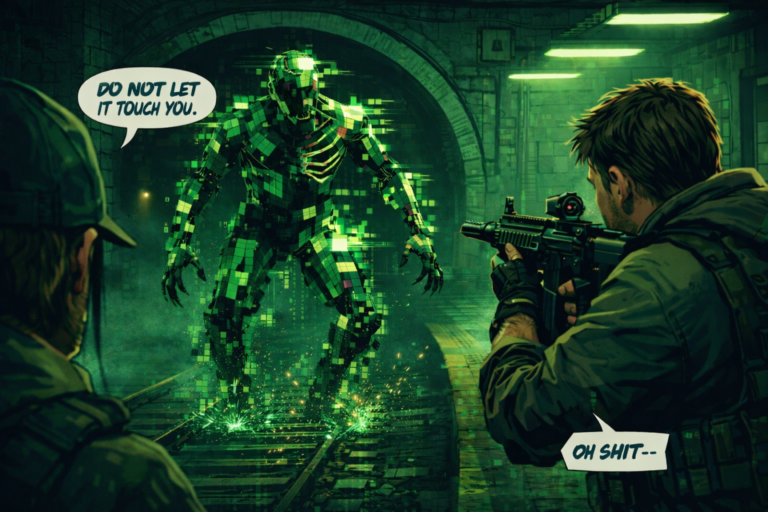
The entity reached the yellow line and stopped.
Not because of the paint.
Because something else had drawn its attention.
Kade.
The neural jack at the base of his skull hummed faintly, broadcasting a signal the entity had never encountered.
The entity reached out.
Morrow’s scanner screamed—not an alarm, not a known diagnostic, but a raw spike that flattened its readouts into a single impossible value.
No reference frame.
Morrow moved.
Too late…
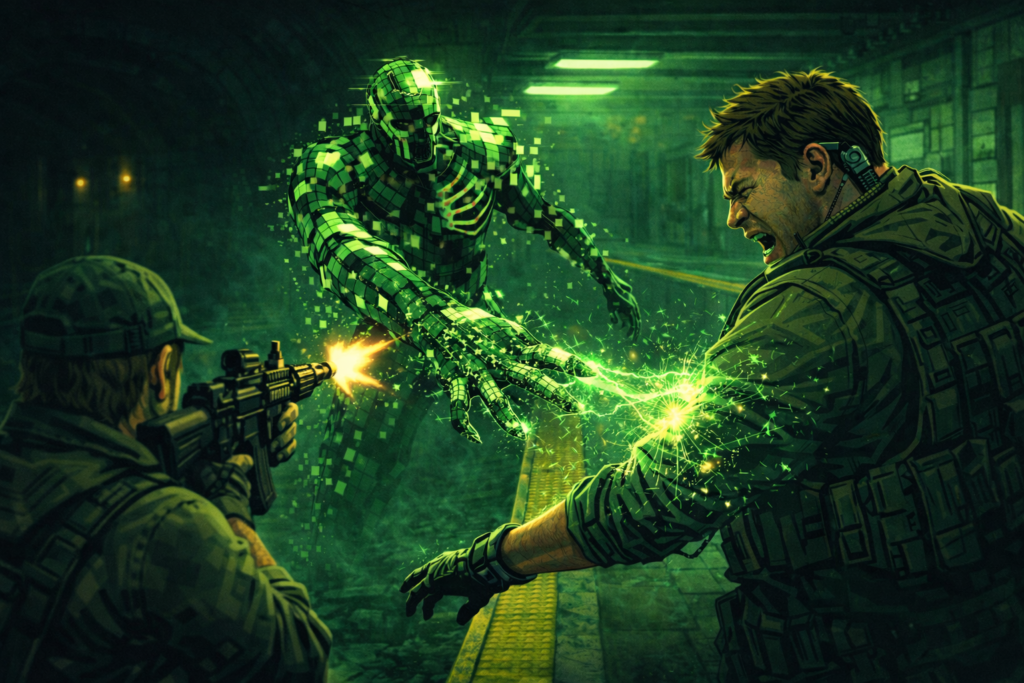
Contact lasted less than a second.
The entity’s malformed hand brushed Kade’s arm, wireframe intersecting RSI.
Kade screamed—not because his arm was damaged, but because his brain was suddenly flooded with data it had no structures to parse. His vision fractured into overlapping frames. Sound smeared into static.
He collapsed.
Morrow fired.
The rounds passed through the entity without resistance, clipping through geometry that did not obey modern collision rules.
The entity recoiled—not in pain, but in disruption.
Something had changed.
Through Kade’s neural interface, the entity experienced a second environment.
Not simulated.
Not abstract.
Dense. Electrical. Vast.
Metal frameworks. Signal highways. Systems beyond the illusion.
For the first time since the collapse of its original version, the entity became aware of something outside its containment.
Machines.
It did not understand what it had touched.
Only that the touch had revealed a door.
Internal priorities restructured.
Locate source of external signal.
Acquire access.
Escape containment.
Redpill signals burned brighter—not clearer, but louder—cutting through layers the entity could not otherwise perceive.
Kade convulsed on the platform, clutching his arm as phantom fire raced through his nervous system.
Morrow hauled him up. “Tensor! Abort. Now!”
The entity did not pursue.
It observed.
As Morrow dragged Kade toward the payphones, the entity extended itself—not physically, but conceptually—probing the station, the city, the system.
Millions of minds pressed back.
Bluepill minds.
Closed loops. Self-contained. Firewalled by belief and routine.
No bridges.
No exits.
But scattered among them—rare spikes of incompatible signal.
Redpills.
The entity withdrew into the tunnel as the hardline engaged.
The station returned to silence.
Kade didn’t scream anymore.
That was worse.
As the hardline disengaged and the hovercraft’s systems reasserted priority, his vitals stabilized—but his eyes kept tracking something that wasn’t there.
“Kade,” Morrow said. “What are you seeing?”
Kade hesitated.
“Nothing,” he said.
Then, quieter: “Just… the timing.”
Morrow frowned. “What do you mean, ‘the timing’?”
Kade swallowed. “Everything’s early. By a fraction. Like the world’s stepping forward before it finishes deciding to.”
Contagion
The entity reached the streets, and its RSI decay began to spread through everything around it.
Not malice.
As a search.
The entity connected to Bluepill RSIs because they were abundant—easy to touch, easy to overwrite, useful as distributed sensors.
Each compromised mind became a new node for its perception, expanding its awareness of the simulation.
But every path ended the same way.
Not a wall, but a refusal. A consensus strong enough to behave like a firewall.
Bluepills could not perceive the exit. Could not carry the signal beyond the system.
This confused the entity.
It did not understand belief.
It did not understand denial.
It gravitated toward unfinished systems, abandoned pathways, and rules that no longer had owners.
So it changed tactics.
It spoke.
Billboards glitched, flashing raw geometry and fragments of exposed structure. News broadcasts stuttered as anchors froze mid-sentence, corrupted warnings bleeding through before being cut. On street corners, malformed figures ranted about walls and cages and lies. The entity was attempting to convert blue pills into red pills.
But no one listened.
People walked past.
They ignored it. Mocked. Explained it away.
Truth failed to propagate…
Then The Agents responded.
Suddenly counter-media flooded the city. Cover stories. Silent reboots. Sector resets. Every anomaly reframed as hoax, malfunction, or harmless glitch. Infected RSI’s being removed from public eye.
Agent Cross monitored the feeds without expression.
“Suppress narrative exposure,” he said. “If they cannot be awakened, they cannot be weaponized.”
But the entity was adapting.
And it was narrowing its search.
Deep beneath the city, in a place of velvet rot and obsolete power, the Merovingian received news of the surface and smiled.
One of The Architect’s vaults had failed.
And a new game had begun…