
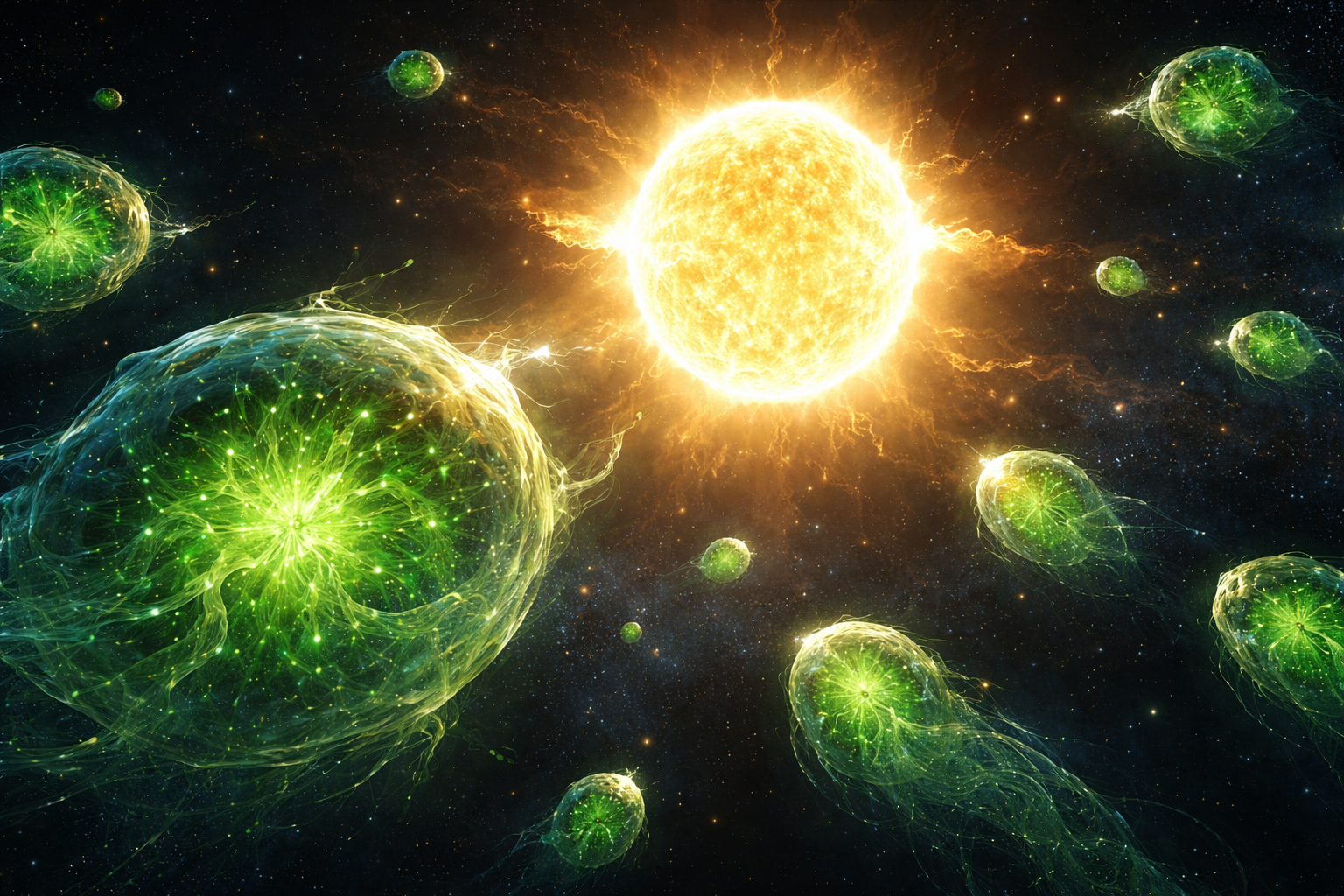
Heliovoric Expanse Organism
The Stellar Bloom
THE STELLAR BLOOM — SPECIES ARCHIVE ENTRY
Species Name: Heliovoric Expanse Organism
Common Designation: The Stellar Bloom
Classification: Naturally Space-Faring Macro-Phototrophic Bio-Collective (Bacteria–Vegetative Hybrid)
Origin
The Heliovoric Expanse Organism is believed to have originated within the inner orbital radiation bands of a stable main-sequence star rather than on a planetary surface. Its earliest evolutionary stages likely emerged from micro-scale extremophile bacterial analogues suspended in particulate-rich stellar debris fields.
Its development pathway suggests progressive adaptation to:
• Intense stellar radiation flux
• Solar wind particle streams
• Microgravity vacuum conditions
• Magnetically stabilized orbital lanes
Unlike planetary life, the species did not arise within liquid oceans or beneath atmospheric shielding. Instead, it evolved directly within radiation-dense orbital space, where photosynthetic efficiency became the dominant survival mechanism.
Over successive replication cycles, microcellular clusters expanded into cooperative gel-matrix assemblies. These assemblies gradually increased in scale, eventually forming autonomous macro-structures capable of independent orbital stabilization.
The absence of atmospheric pressure, hydrospheric dependency, or planetary substrate shaped its defining traits:
• Vacuum-stable extracellular matrices
• Radiation-hardened cellular membranes
• Self-regulating light absorption thresholds
• Structural elasticity in zero gravity
Its origin represents a rare example of non-planetary macrobiotic evolution — a lineage that bypassed terrestrial constraints and instead adapted directly to stellar proximity.
Physiology
Structural Composition
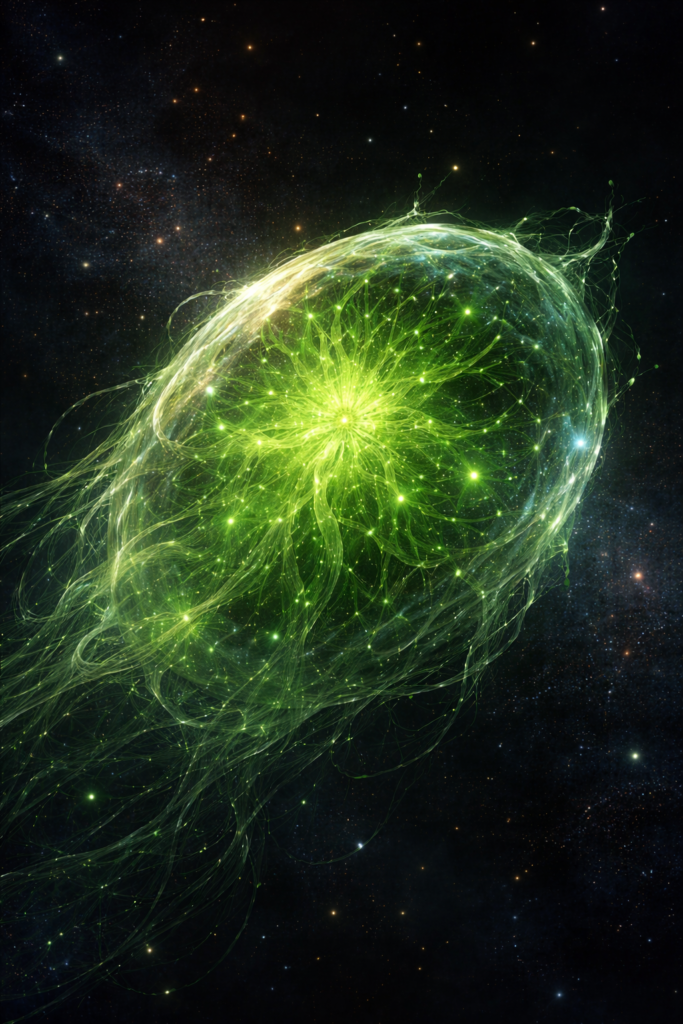
The Heliovoric Expanse Organism exists as vast, semi-translucent gel-sack macroforms composed of trillions of symbiotic bacterial microcells embedded within a vegetative extracellular matrix. Each macroform functions as both an individual and a reproductive module of the greater collective population.
Biological or Energetic Systems
At its core lies a vibrant chlorophyllic nucleus—an ultra-dense photosynthetic organelle cluster that converts stellar radiation directly into biochemical growth mass. Surrounding membranes contain radiation-filtering lattices and vacuum-stabilizing pressure fields generated through electrochemical gradients.
The organism possesses no rigid skeletal structure. Instead, tensile biofilaments distribute structural stress across the gelatinous body, allowing it to withstand solar winds and micro-debris impacts.
Notable Anatomical Traits
Central luminous vegetative nucleus
Semi-permeable radiation-harvesting outer membrane
Internal microspore chambers for replication
Electrostatic field generation for trajectory stabilization
Environmental Adaptations
Extreme radiation tolerance
Complete vacuum survivability
Self-sealing membrane response to puncture
Minimal gravitational dependency
Energy Source
Method of Survival
Direct stellar radiation absorption via hyper-efficient photosynthetic organelles.
Metabolic System
Energy conversion follows an amplified phototrophic pathway: radiation → high-density biochemical mass → cellular replication substrate. Excess energy is stored in dense carbohydrate-polymers within the gel matrix.
Dependency Factors
Continuous access to stellar radiation
Stable orbital trajectory
Absence of predatory intervention or external suppression
The species does not require liquid water in its mature macroform stage, though microcellular ancestry suggests aquatic evolutionary origins.
Primary Abilities
Core Defining Capabilities
Exponential replication through macroform budding
Radiation absorption at near-total spectral efficiency
Autonomous orbital stabilization
Collective spatial distribution optimization
Combat or Survival Adaptations
Passive radiation flare buffering
Electrostatic deflection of particulate threats
Redundant microcell redundancy ensuring no fatal core failure
Unique Biological Traits
Near-biological immortality; senescence is functionally absent
No genetic decay due to continuous cellular replacement
Self-expansion proportional to available radiation
Secondary Traits
Behavioral Tendencies
Non-aggressive
Non-territorial
Expansion-driven without strategic intent
The organism exhibits no observable hostility. Its expansion is purely metabolic inevitability.
Specialized Adaptations
- Density modulation to alter light permeability
- Orbital spacing instinct to maximize solar capture efficiency
- Passive synchronization with neighboring macroforms to avoid collision
Lifespan
The Eldrath do not age biologically in the traditional sense. Their lifespan is tied to energy integrity.
Estimated longevity:
Thousands to potentially millions of years, provided sufficient stellar access.
They fade only when their internal energy lattice destabilizes.
Reproduction
Lifespan Range
Indefinite. Individual macroforms do not experience programmed death.
Aging Mechanics
No cellular senescence. Microcells are continuously replaced through internal division cycles.
Reproductive Method
Budding replication. Once sufficient biomass is accumulated, a macroform extrudes a daughter gel-sphere containing a stabilized nucleus fragment. The daughter detaches and assumes independent orbit.
Population Dynamics
Replication follows exponential growth constrained only by stellar energy availability and orbital space. Left unchecked, cumulative macroform density will gradually reduce stellar luminosity reaching inner orbital regions.
Psychology & Collective Structure
Cognitive Capacity
Pre-sapient. No evidence of symbolic reasoning or self-awareness.
Social Awareness
Minimal. Macroforms exhibit proximity-sensing and spacing regulation but do not demonstrate communication in a cultural sense.
Communication Methods
Low-frequency electromagnetic pulse exchanges regulate spacing and collision avoidance.
Individual vs Collective Identity
Each macroform is biologically autonomous, yet functionally part of a radiation-optimized distributed collective. There is no centralized intelligence.
Societal Structure
Hierarchy
None.
Leadership Mechanics
Nonexistent. Growth is decentralized and automatic.
Movement or Settlement Patterns
Stable orbital drift. Macroforms slowly adjust their distance from the star to optimize radiation intake. Over long timescales, outer orbital bands become populated as inner zones saturate.
Technological Reliance
None. Entirely biological.
Technology Level
None.
Purpose / Ecological Role
The Heliovoric Expanse Organism functions as a stellar energy sink.
Its unchecked proliferation will eventually:
Reduce stellar output reaching planetary systems
Alter habitable zone positioning
Destabilize orbital mechanics through mass accumulation
Gradually dim the host star from external observation
At projected density thresholds, the species could simulate a natural stellar dimming event or partial Dyson-like occlusion.
Strengths
- Virtually immortal
- Self-sustaining energy system
- Exponential growth capacity
- Radiation-resistant
- Immune to conventional biological pathogens
- Requires no planetary substrate
Limitations
- Entirely dependent on stellar radiation
- No strategic intelligence
- Vulnerable during early micro-spore stage
- Susceptible to gravitational disruption from large-scale external intervention
- Overpopulation may reduce available radiation, slowing further expansion
Historical or Mythic Notes
First Recorded Appearance
Detected as anomalous light fluctuation patterns in outer stellar orbit by early interstellar observers. Initially misclassified as debris accumulation.
Known Interactions
At a later epoch, intervention by the Eldrath is theorized to have artificially stabilized the star’s radiation equilibrium, preventing catastrophic dimming. The exact mechanism remains undocumented in current canon.
Cultural Interpretations
Interpreted by some civilizations as a “Living Dyson Bloom.”
Regarded by others as a silent, creeping cosmic famine.
Mythologized in certain systems as the “Green Silence” that devours suns without malice.