
Inside the SPK-Class Juggernaut: Maverex Corp’s Walking Fortress
The SPK-Class Juggernaut is the ultimate expression of Terran security. It is a hulking, heavily armored mechanical behemoth designed to protect Maverex Corp’s most vital interstellar assets.
Blending brutal acoustic technology with relentless kinetic firepower, advanced energy shielding, strategic mobility protocols, and sophisticated active camouflage, these units serve as the unyielding guardians of the Terran expansion. Among the Cerulean infantry and fleet operators who fight alongside them, these towering acoustic dreadnoughts have earned a simple, fitting nickname: “The BoomBox.”
Unit Specifications:
Classification: Heavy Security / Starflight Suppression Unit
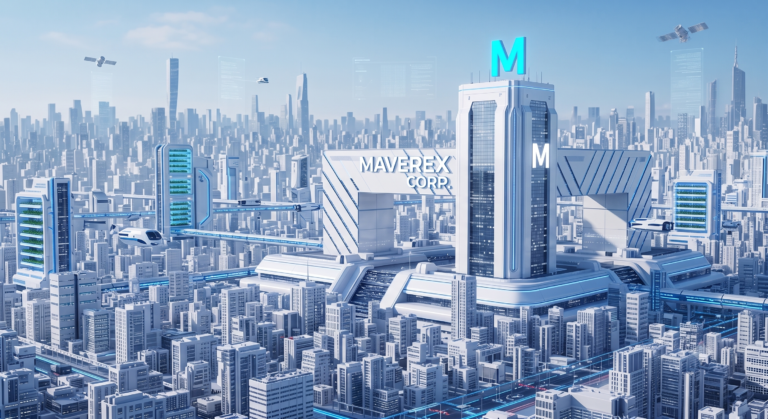
Manufacturer: The Maverex Corp.
Signature Aesthetic: Clinical White and Blue (Heavily Sloped Poly-Metallurgical Armor)
Colloquial Designation: “The BoomBox”
Primary Directive: Starflight defense, orbital shock-drops, localized suppression, and psychological deterrence.
Here is a deep dive into the mechanics, armaments, and unique integration protocols of the Maverex fleet’s premier security drone.
Acoustic Warfare Mechanics
The Primary Subwoofer Array
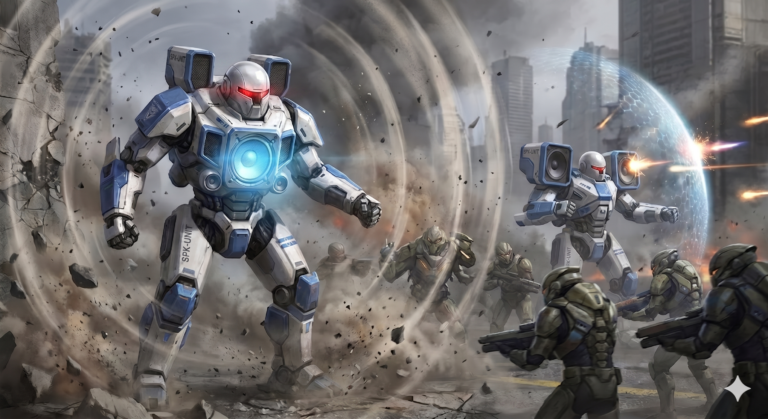
The defining feature of the SPK-Class Juggernaut Unit isn’t traditional ballistics—it’s weaponized sound (Sonic Pulse Kinetics). Built directly into the massive chest cavity of the drone is a specialized Zero Point Energy (ZPE) powered acoustic array.
This primary subwoofer is capable of releasing directed infrasonic booms. When charging for a high-yield blast, the unit emits a distinct, dropping bass tone—a massive, cinematic “Braaam”—right before unleashing a resonant wave that instantly shatters incoming projectiles, ruptures biological targets, or liquefies solid stone.
Auxiliary Sonar Drivers
Secondary acoustic drivers are deeply recessed into the armored pauldrons (shoulders) and greaves (lower legs).
These auxiliary speakers constantly emit inaudible frequencies, allowing the unit to project high-fidelity, 360-degree sonar mapping. The sheer, vibrating power of these localized sonar emissions actively distorts local gravity; as a Juggernaut patrols, loose pebbles and debris can be seen floating an inch off the ground with every booming footstep.
Advanced Shielding & Power Routing Protocols
Armored Bracer and Bubble Shield System
Opposite the modular gun arm, the SPK-Class features a reinforced bracer that doubles as an advanced Energy Shield Generator. In standard combat, it projects a frontal barrier.
In extreme defensive scenarios, the generator can expand to fully encase the entire Juggernaut in an impermeable bubble shield, offering absolute protection from physical and energy-based attacks.
Power Routing Limitation: Generating the bubble shield consumes massive amounts of energy. While the shield is active, power is routed away from mobility actuators and weapon systems. The Juggernaut becomes an invulnerable, stationary bunker, unable to move or return fire until the shield is dropped.
Quantum Rephasing (Matter Escape)
If the unit is severely deformed or fully encased within solid matter (e.g., a collapsed subterranean structure), it can initiate Quantum Rephasing. The Juggernaut temporarily shifts its matter out of local reality to decouple from the obstruction, allowing it to “rephase” to safety.
Power Routing Limitation: This extraordinary maneuver critically drains the ZPE core. Following a phase-shift, the unit experiences a mandatory 60-second power cycle. During this window, energy shields and primary weapons are offline, leaving the unit highly vulnerable to counterattacks.
Kinetic Suppression & Mobility Protocols
The Modular Weapon Hardpoint
The unit’s non-shield arm is a fully modular hardpoint dedicated to heavy suppression. The standard attachment is the heavy rotary ZPE gatling cannon. Powered by the integrated core, it materializes super-heated kinetic slugs directly from the vacuum of space for infinite suppressive fire.
Other standard attachments include a concentrated ZPE Laser Cannon for anti-dreadnought armor piercing, a Microwave Emitter Weapon (MEW) for organic pacification, or a heavily armored secondary manipulator hand for complex subterranean excavation.
Ballistic Leaps & Flight Systems
Because of its immense weight, the Juggernaut’s heavy boosters alone are not always efficient for immediate liftoff.
To compensate, the lower actuators compress and launch the unit off the ground like a spring-loaded ballistic missile. Operating much like a mechanical jumping spider, this instantaneous, crushing leap shatters the ground beneath it and provides the necessary vertical velocity for the thrusters to take over.
The Comet Drop
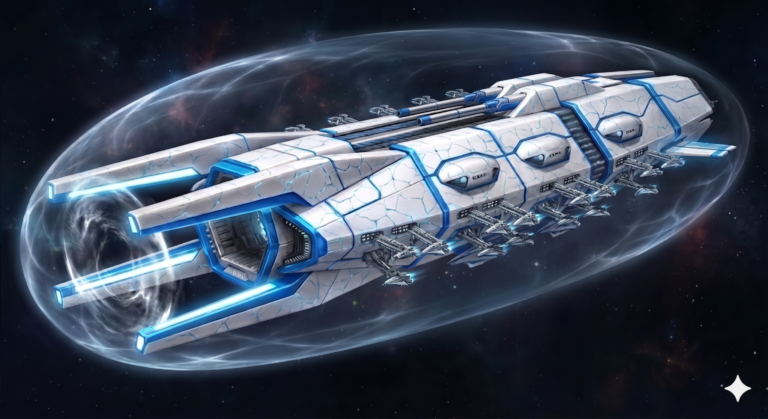
When deployed from a cruiser in orbit, the Juggernaut jumps from the airlock and curls into a tight, reinforced sphere. Using its sloped armor as a heat shield, it strikes the planet’s surface like a metallic comet. The resulting kinetic impact causes a devastating crater, obliterating the landing zone before the unit unfolds.

Sensory Arrays & Utility Systems
Rapid-Axis Targeting
The unit’s head is a dedicated sensory dome, housing a dense cluster of multi-spectrum optics, LIDAR, and thermal-imaging nodes. The head can rapidly rotate a full 360 degrees on its primary collar, while the dual optic sensors (the “eyes”) feature an independent, high-speed 180-degree counter-axis. This allows for instant, omnidirectional target acquisition without the Juggernaut ever having to adjust its massive, lumbering posture. For a Cerulean pilot synced inside, this influx of raw telemetry is filtered through a predictive combat HUD, preventing neural overload while granting the pilot a terrifying, god-like awareness of the battlefield.
Active Camouflage
The clinical white and blue hull is composed of microscopic nano-metallurgical scales. When secrecy or ambush tactics are required, these scales facilitate Active Camouflage. They do not merely bend light; they act as high-density sensory and projection pixels, rendering a real-time, high-fidelity holographic replication of the surrounding environment. Furthermore, the scales simultaneously dampen the unit’s immense thermal and acoustic signatures. This organic-like surface allows the stark hull to seamlessly blend into deep-space starfields, urban rubble, or dense jungle canopies. The psychological terror of a twenty-ton mechanical behemoth moving completely unseen cannot be overstated.
Power Routing Limitation: Maintaining this multi-spectrum, high-fidelity cloak requires intense, constant processing power. If the ZPE Rotary Cannon or the primary subwoofer is fired, the sudden, massive energy spike instantly breaks the camouflage. The uncloaking effect is often violent—a sudden, rippling tear in reality that reveals the towering dreadnought just milliseconds before it unleashes absolute devastation.
Anomalous Energy Glitches (The Physics Dependency)
Because Zero Point Energy technology relies entirely on the rigid, mathematical constants of the physical universe, the SPK-Class is theoretically vulnerable to non-standard phenomena. Should the unit ever deploy to a frontier like Atavice and encounter anomalous, reality-bending energy fields (such as high-density magic), it faces unprecedented operational hazards. The Juggernaut’s AI expects the universe to follow absolute rules; when a magical attack introduces an “impossible” variable, the sensory telemetry can suffer severe degradation. This mathematical paradox forces the ZPE core into a forced stutter or temporary reboot, creating a terrifying vulnerability where the Terran war machine momentarily freezes to reconcile a broken reality.
Self-Destruct Protocol
If a Juggernaut is critically incapacitated, boarded, or unrecoverable, the unit’s core AI—or the synced Cerulean pilot—can initiate a finalized, irrevocable Self-Destruct Protocol. This is a “Dead Hand” asset denial system with mission-appropriate, variable yields. On its lowest setting, the unit unleashes a localized thermobaric burst, designed to instantly vaporize the drone’s classified internal databanks and neutralize any hostile boarding parties without heavily damaging surrounding infrastructure. However, at its maximum, apocalyptic setting, the ZPE core is intentionally and violently destabilized. The Juggernaut emits a blinding, rising shriek before culminating in a detonation equivalent to the yield of an advanced hydrogen bomb, ensuring the total erasure of the unit, the enemy, and the surrounding geographic region.

The Cerulean Override (Piloted Integration)
The Shell Protocol
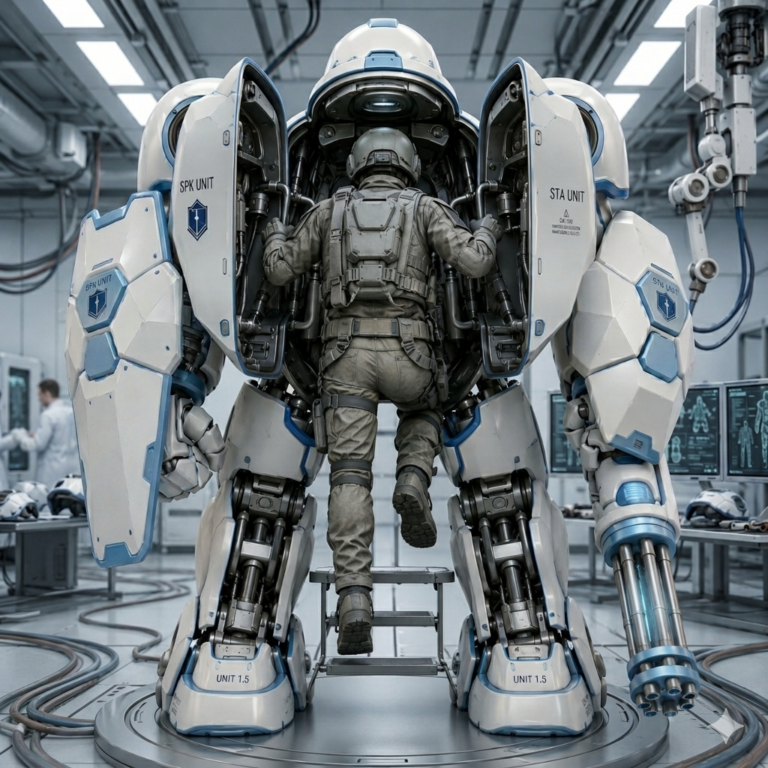
While fundamentally an autonomous drone, the SPK-Class harbors a classified override. When a situation requires manual Terran intuition, the Juggernaut’s front carapace hydraulically splits and folds outward, revealing a shielded internal cockpit scaled for a Cerulean Heavy Unit (an elite Terran pilot in Cerulean infantry armor).
The Vulnerability Window: This “Suit Within a Suit” integration is the unit’s most dangerous operational phase. When the carapace opens, the Juggernaut’s primary armor and shields are entirely dropped. The 5 to 10 seconds it takes for the pilot to step in, lock the interface, and allow the heavy hydraulic shell to close requires absolute, desperate covering fire from allied squads.
Once secured, the pilot syncs with the ZPE core, gaining unparalleled ablative armor and absolute manual control over the “BoomBox” in the deadliest combat zones.
Remote Operation & VR Sync
Cerulean units can also remotely hijack a Juggernaut, piloting it like a drone from a long distance. Furthermore, fleet operators can command these units directly from specialized VR chairs aboard orbiting cruisers, projecting their consciousness into the heavy armor to fight across the surface while remaining safely in the void.
Notable Appearances
TBD